
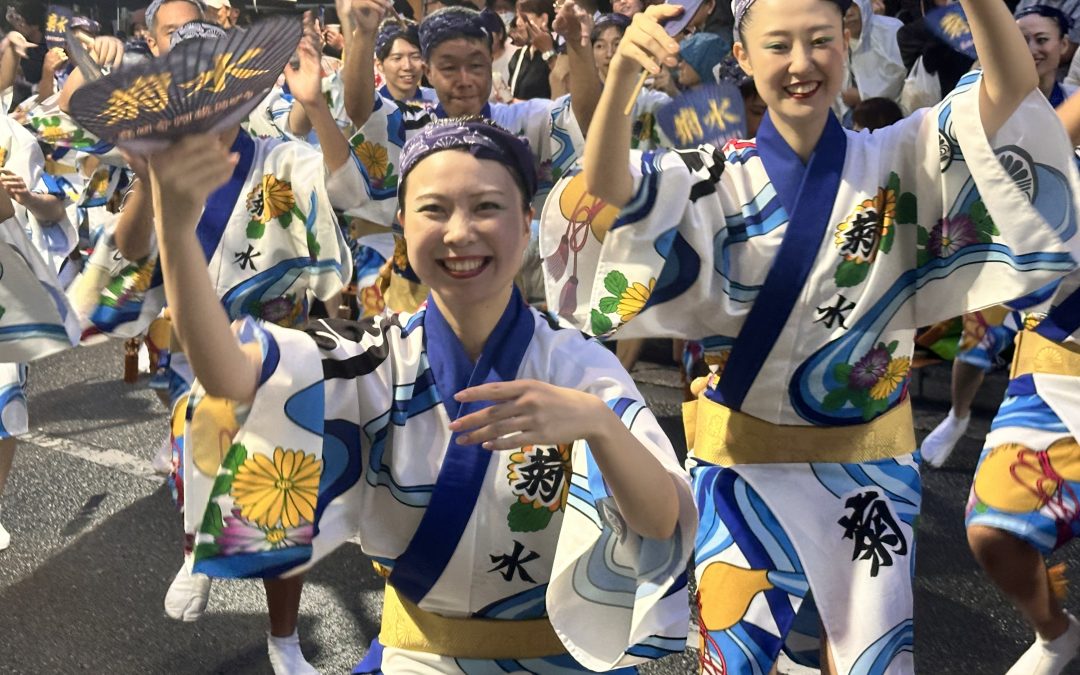
Some festivals are fun to watch. Awa Odori is hard to simply watch.
I saw the Koenji Awa Odori, and the streets were packed. Rhythmic drumbeats seemed to come from every direction; dancers moved through the crowds in colorful yukata, gliding gracefully through the air, and every group brought its own energy.
The Koenji Awa Odori, one of Tokyo’s biggest summer dance festivals, with more than 10,000 dancers and around one million spectators filling the neighborhood over two days, is celebrating its 67th anniversary this year.
What struck me about the dance festival wasn’t just the energy and how flawless it looked. It was how much work was hiding underneath that joy. The dancers made it look easy, but the precision was unmistakable. You could see the practice in the timing, the way people moved together, the way one person’s step fit precisely with the next. Everyone knew exactly what they were doing.
And still, it felt light. Fun. Almost effortless.
Every Relationship Has Its Own Rhythm
Watching the dancers, I started thinking about how relationships develop their own choreography too.
Spend enough time with someone, and you learn each other’s moves. You know who tends to make the plans, who remembers the birthdays, who wants to talk things through immediately, and who would rather revisit the conversation sometime next year.
Unlike in a choreographed dance routine, nobody assigns these roles in a relationship. They usually just develop.
Sometimes that familiarity is wonderful. A close friend knows exactly what you’ll order. Your partner can tell something is wrong before you’ve said a word. Families end up with traditions no one remembers starting, but everyone would miss if they disappeared.
Then there are the routines that aren’t quite as charming.
- Maybe one person asks, and the other almost always agrees.
- Maybe one person waits long enough, and the other eventually takes over.
- Maybe one gets frustrated, and the other backs down because that feels easier than continuing the conversation.
Do something often enough and eventually it stops feeling like a pattern. It starts feeling like, This is just how we are.
Usually, ‘rehearsed’ over time, each person’s move becomes automatic. Much like the moves of dancers who have been training consistently.
What Happens When One Person Changes a Step?
At Awa Odori, a dancer can’t suddenly move in a completely different direction without affecting the people around them. The dancers are too connected for that.
Relationships are obviously messier, but there’s something similar happening there.
We can get so focused on what we want someone else to change that we miss what we can do.
We want more help, but we still jump in before the other person has a chance to handle something. We want more honest conversations, but as soon as things become uncomfortable, we help change the subject. – We complain that no one supports us, then find ourselves saying, “No, no, I’ve got it,” when support is actually offered.
None of that means we caused the other person’s behavior. It also doesn’t mean changing what we do will magically make someone else behave the way we want.
It simply means we have a part in the interaction too.
And if our part changes, the interaction can’t stay exactly the same.
- Maybe you listen instead of immediately defending your point.
- Maybe you stop reminding someone five times and let them decide what to do.
- Maybe you ask what your partner needs instead of assuming you already know.
The new step might be tiny. But it’s still a different step.
The Patterns We Stop Seeing
The tricky part is that our relationship patterns aren’t nearly as obvious as the choreography at Awa Odori.
At the festival, you can see the dance. You can watch the timing. You can see who moves where. And you can sometimes catch an obvious blunder.
In our own lives, we’re standing inside the pattern.
That makes it much easier to notice what the other person is doing than to notice our own predictable response to it.
What part of the interaction do you actually want to change, and what do you usually do when that moment arrives?
Maybe the next argument doesn’t need to be won. Maybe it needs a pause and a little closeness instead. Maybe, rather than pushing for your partner to change something right away, you notice something you genuinely appreciate and say it out loud. Or perhaps you simply try one different response and see what happens to the rhythm between you.
Sometimes the pattern becomes visible only when we stop focusing on the other person’s steps long enough to notice our own.
That’s also where boundaries – or weak boundaries – become part of the choreography without us noticing.
If that sounds familiar, you may recognize some of the same patterns in Why Saying No Feels So Guilty — And How to Stop Overcommitting for Good.
Not Every Dance Needs Fixing
There’s comfort in knowing someone well enough that certain things happen almost automatically. Those routines are part of what makes relationships feel familiar and connected.
The question isn’t whether we have patterns. Of course we do.
The more interesting question is whether the pattern still works for the people in it.
By the time the Awa Odori dancers moved farther down the street, I stopped analyzing the whole thing and went back to enjoying the festival. There was too much music, movement, color, and sheer happiness around me not to.
But I was watching differently.
What looked effortless had been practiced over and over until everyone knew the steps.
And I couldn’t help wondering how many steps we practice in our own relationships without ever realizing we’re practicing them.
If there’s a relationship in your life you’d like to see change, maybe the first question isn’t, How do I get the other person to do something different?
Maybe it’s simply:
What happens if I change one of my steps?
Recent Comments